

Executive Summary
A performance marketing focused client approached us with a clear operational challenge. Their team needed to understand competitive advertising activity at scale, but their existing manual research process was slow, inconsistent, and impossible to scale across markets.
They were spending hours manually reviewing ads, extracting insights by hand, and attempting to identify meaningful patterns before competitors moved. As their advertising volume and competitive landscape grew, this approach became a bottleneck.
We designed and implemented a custom Automated Marketing Research Tool that transformed their marketing research workflow. The solution reduced analysis time by over 99 percent, enabled market wide visibility, and allowed the client to reallocate human effort toward strategy and execution instead of repetitive data review.
The Challenge: Manual Competitive Research Does Not Scale
Before engaging with us, the client relied on manual ad analysis performed by internal team members. Each ad required individual attention to determine relevance, intent, and competitive significance.
Internal benchmarking and industry practice indicate a human analyst typically needs 30 to 60 seconds per ad to read, interpret, and classify ad creative and its landing-page context, depending on complexity. On average, an analyst reviewing online content such as text, landing pages, or ad descriptions will spend tens of seconds per item, based on established digital reading research and performance benchmarks. Recent literature on digital reading speed and comprehension confirms that standardized reading measures such as WPM remain relevant in web contexts (see Evaluating Reading Speed and Comprehension in the Digital Era, 2025). ResearchGate
At that pace, reviewing 15,000 ads would require:
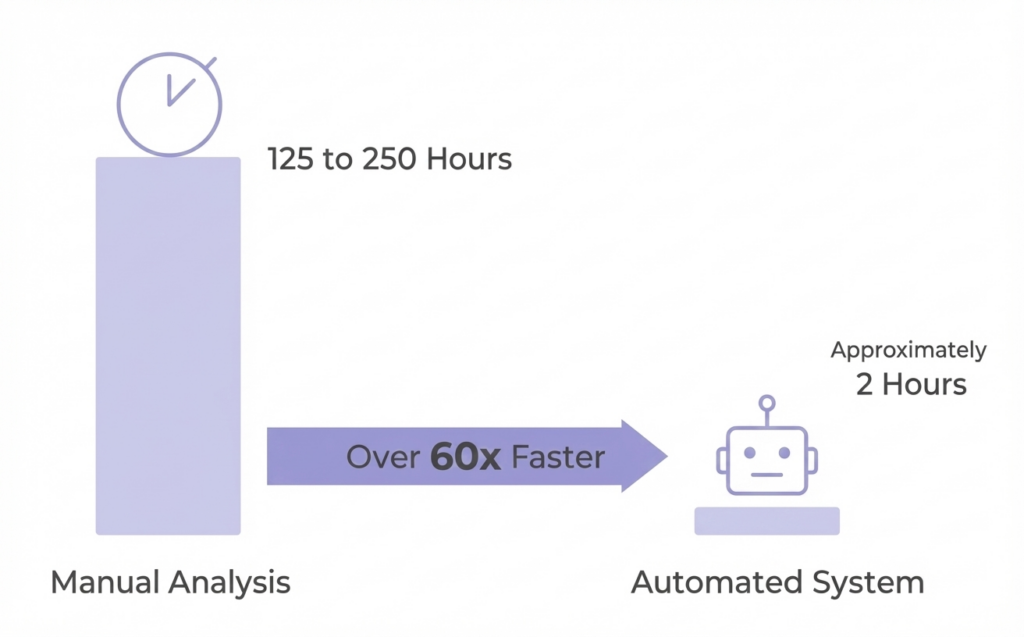
- Approximately 125 to 250 hours of focused human labor
- The equivalent of 3 to 6 full work weeks for a single analyst
This made comprehensive competitive research impractical, expensive, and delayed.
The Solution: Automated Marketing Research Tool
We built a tailored automation system specifically for the client’s operational needs. The goal was to enable large scale research without increasing headcount or sacrificing analytical rigor.
The solution was designed to:
- Process large volumes of advertising data in parallel
- Normalize fragmented signals into consistent structures
- Classify ads based on commercial relevance
- Group campaigns by shared business indicators
- Track longevity and frequency as indicators of market validation
All outputs remain structured, auditable, and ready for strategic decision making.
How the System Works (High Level)
To protect client confidentiality, specific data sources and collection methods are intentionally not disclosed.
At a high level, the system:
- Ingests large volumes of advertising content automatically
- Applies structured classification logic to identify relevant campaigns
- Consolidates related campaigns under unified business signals
- Measures consistency and duration over time
- Outputs clean, decision ready datasets
This allows the client to identify meaningful competitive patterns without manual review.
Time Savings: Quantified Impact
Manual Versus Automated Analysis
| Method | Ads Analyzed | Time Required |
|---|---|---|
| Manual analysis | 15,000 ads | 125 to 250 hours |
| Automated system | 15,000 ads | Approximately 2 hours |
This represents a time savings of:
- 123 to 248 hours per research cycle
- Multiple weeks of analyst effort eliminated
The client can now perform market wide analysis on demand instead of as an occasional, resource intensive exercise.
Business Impact
Faster Market Entry Decisions
The client can now identify sustained advertising activity early, allowing them to validate opportunities before markets become saturated.
Improved Budget Allocation
By focusing on campaigns that demonstrate consistency over time, the client allocates spend toward proven opportunities rather than short lived experiments.
Scalable Competitive Intelligence
What was previously limited to small samples can now be applied across entire markets and regions.
Reduced Operational Cost
Automation replaced repetitive manual work, reducing reliance on large research teams while increasing output quality.
Why Automation Changed the Outcome
The client did not lack expertise. The constraint was scale.
Humans are not designed to process thousands of data points consistently and quickly. Automation enabled the client to shift from reactive research to proactive market intelligence, supported by structured and repeatable analysis. The analysts now had increased their output while maintaining the level of expertise.
Results at a Glance
- 15,000 ads analyzed in approximately 2 hours
- Over 99 percent reduction in analysis time
- Weeks of manual effort eliminated per research cycle
- Scalable and repeatable research framework
- Higher confidence in competitive and market decisions
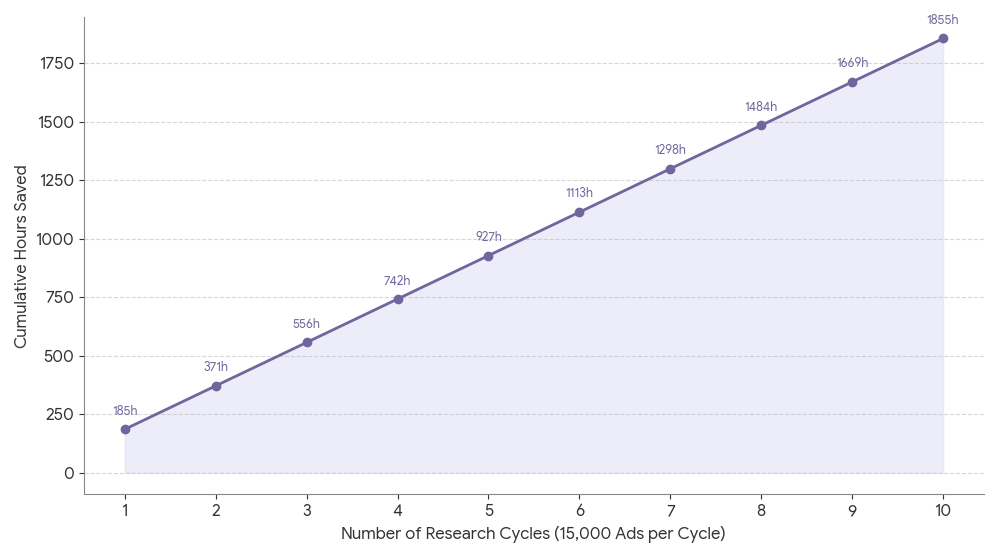
Graph 1. Cumulative time savings over repeated research cycles
Assumptions:
- Manual Analysis: Averaged at 187.5 hours per cycle (midpoint of 125–250 hours).
- Automated System: Constant at 2 hours per cycle.
- Savings per Cycle: Approximately 185.5 hours.
As shown, the savings accumulate rapidly, exceeding 1,800 hours of work saved after just 10 cycles.
Conclusion
This engagement demonstrates how a purpose built Automated Marketing Research Tool can fundamentally change how businesses approach competitive intelligence.
By replacing manual review with scalable automation, the client gained speed, consistency, and strategic clarity. What once took weeks can now be accomplished in hours, enabling better decisions and sustained competitive advantage.
Torm Erik Raudvee
04.01.2026

Boost Your Business Success Now
Begin your journey with us now. Unlock the potential of your business with our innovative solutions designed to boost your success and propel you towards your goals.