

Executive Summary
A growing service based company approached us with a clear challenge. They knew that automation could improve efficiency and scalability, but they did not know where to start or which initiatives would deliver the highest return. Rather than jumping straight into implementation, the client wanted a structured and objective way to determine what their business actually needed most.
We guided the client through a discovery driven process that identified operational bottlenecks, clarified priorities, and outlined a phased automation roadmap. By focusing on business practices rather than tools, we helped the client make confident decisions and build a foundation that allowed future solutions to stack logically and cost effectively.
Client Background and Initial Challenge
The client operates in a fast moving environment with multiple ongoing projects, recurring internal coordination, and constant client communication. While the team was experienced and capable, they spent much of their time on repetitive tasks, manual coordination, and recreating similar work across projects.
The client approached us with three key concerns:
- They felt operationally stretched despite having skilled people
- Growth seemed to require immediate hiring rather than smarter processes
- Previous automation ideas felt fragmented and risky to implement
They needed clarity before committing to any technology investment.
Our Approach: Business First, Solutions Second
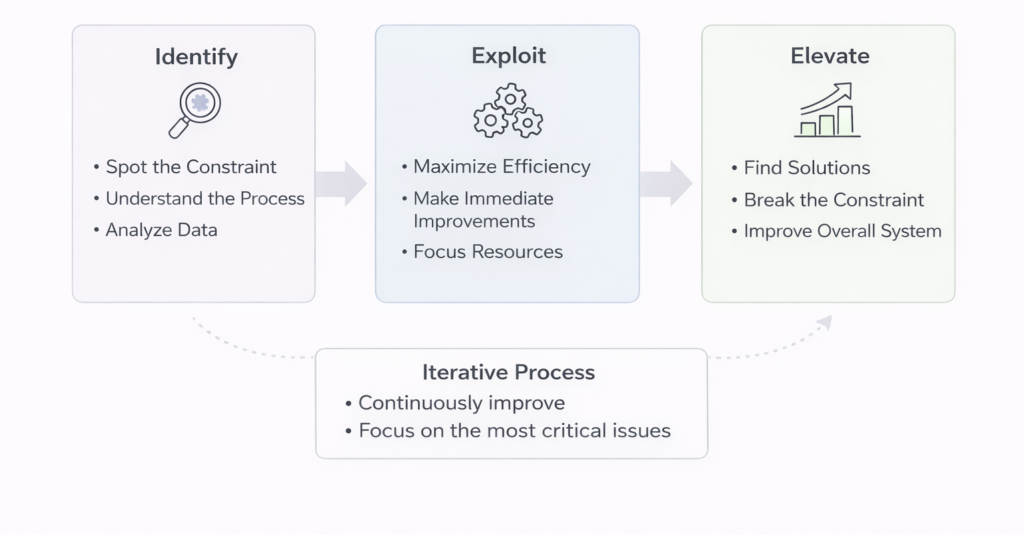
Instead of proposing predefined solutions, we started with a structured discovery process focused on how the business actually operates day to day. This approach is grounded in established operations consulting practices, including value stream analysis, waste identification, dependency risk assessment, and constraint based stress testing.
We designed a guided questionnaire and used it during live sessions with stakeholders. The questions focused on:
- How work flows through the organization today
- Where time is consistently lost or duplicated
- Which processes depend too heavily on individuals
- What would break first if workload increased by twenty to thirty percent
This final stress test style question is commonly used in constraint analysis, as described in The Goal by Eliyahu M. Goldratt, to identify the weakest points in a system before scaling. This approach helped us establish the present situation and identify real problems before we discussed any form of automation.
Key Insights Discovered
Through the discovery process, several clear patterns emerged.
First, the team spent a significant portion of their operational effort on recurring coordination and information retrieval rather than high value work. Second, many processes followed clear rules, yet teams still handled them manually. Third, several future initiatives depended on the same underlying information and decision logic.
These insights revealed that the biggest opportunity was not a single automation, but a sequence of improvements that could build on each other.
Structuring the Options: A Layered Roadmap
Based on the insights, we outlined a phased approach with clear options rather than a single recommendation.
The first phase focused on stabilizing the foundation. This included improving how information was captured, reused, and made accessible across the team. The goal was to reduce repetition and create shared context.
The second phase focused on leveraging that foundation to support more complex decision making and coordination. By this point, earlier improvements significantly reduced the effort required to introduce new processes.
The final phase focused on scale and oversight. At this stage, the client could confidently introduce advanced systems because the underlying data and workflows were already consistent and reliable.
Each phase built directly on the previous one, which reduced risk and prevented duplicated effort.
Results and Business Impact
By the end of the engagement, the client achieved clarity on where to invest first and why. They avoided over engineering early solutions and instead focused on quick wins that created long term leverage.
The client reported:
- Clear prioritization of initiatives with measurable impact
- Reduced uncertainty around future investments
- A structured roadmap that aligned with business goals
- Increased confidence among stakeholders
Most importantly, the client now had a repeatable framework for evaluating future improvements without relying on guesswork.
Why This Approach Works
This case demonstrates that successful automation starts with understanding business practices, not technology. By focusing on how teams actually do their work and how improvements compound over time, companies avoid fragmented solutions and maximize return on investment.
This structured, insight driven approach is especially effective for organizations that want to grow sustainably without increasing operational complexity.
Conclusion
Helping the client determine what they needed most was not about selling a specific solution. Instead, we focused on creating clarity, reducing risk, and enabling smarter decisions. By outlining options and showing how they build on each other, we empowered the client to move forward with confidence and a clear sense of direction.
If you are exploring automation but unsure where to start, this approach ensures that every step is aligned with real business needs and long term growth.
Torm Erik Raudvee
04.01.2026

Boost Your Business Success Now
Begin your journey with us now. Unlock the potential of your business with our innovative solutions designed to boost your success and propel you towards your goals.