

Running a business should feel like building momentum, not dragging a boulder uphill. Yet many teams don’t struggle because they lack talent or demand. They struggle because process bottlenecks choke the flow of work.
This post shows you the clearest signs your business has process bottlenecks, why they appear, and what to do next. If you spot yourself in multiple sections, you don’t need more hustle. You need better flow. Process bottlenecks is the exact problem you need to diagnose and fix.
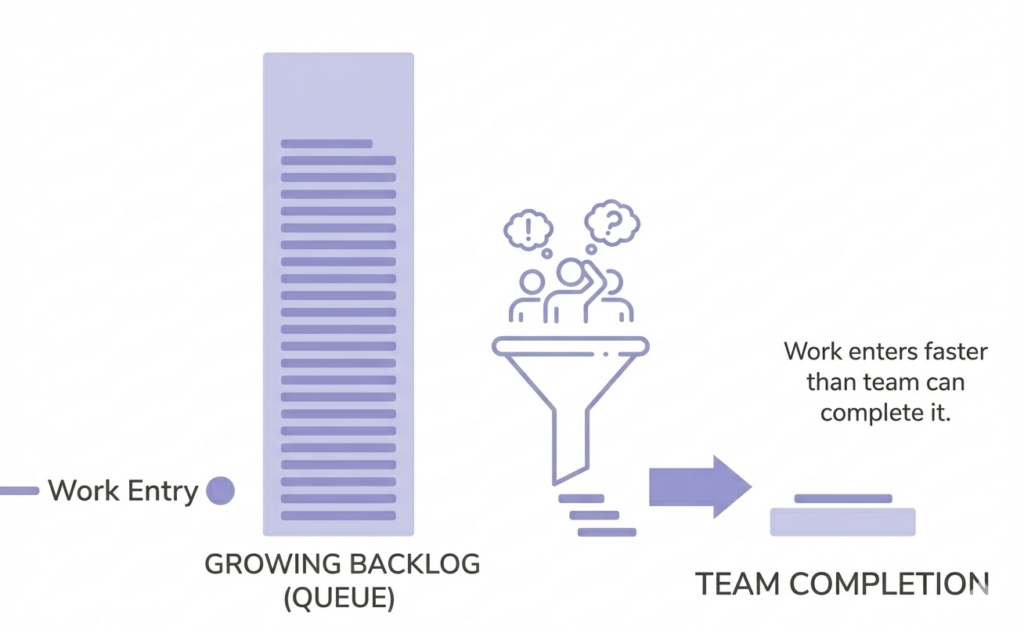
1) Work queues keep growing no matter how hard people work
If your team finishes tasks but the backlog never shrinks, you run a queueing problem, not a productivity problem. As seen in Little’s Law: If WIP rises, lead time rises (even if everyone is “busy”). Process bottlenecks form when work enters your system faster than your team can complete it.
Look for these signals:
- Your “urgent” list grows every day.
- People multitask just to survive.
- Small requests take days because everything waits in line.
What to do next:
- Identify the step where work piles up.
- Put a hard cap on work-in-progress for that step.
- Create a standard intake form so work arrives complete.
2) Approvals choke delivery and turn leaders into gatekeepers
If every meaningful task needs a decision from one person, you build a single point of failure. Leaders often think they “protect quality,” but they actually create process bottlenecks.
You’ll notice:
- Projects stall at “waiting for review.”
- People DM leaders instead of using a system.
- Teams delay decisions because leaders stay unavailable.
Fix it:
- Define approval thresholds (what needs review vs what doesn’t).
- Replace subjective review with checklists and templates.
- Delegate approvals based on risk, not ego.
3) Your business breaks when one person goes offline
If vacations trigger chaos, your company depends on heroes. Heroes cause fragile operations. Fragile operations produce process bottlenecks.
Watch for:
- One person “owns” key client context.
- Only one person can send invoices, handle onboarding, or run reporting.
- The team delays tasks because they wait for the same person.
Fix it:
- Document the critical path, not every detail.
- Build a shared source of truth for client data.
- Automate handoffs so nobody acts as human glue.
4) You re-enter the same data across tools
When people copy and paste between systems, you pay a tax on every transaction. That tax grows with every new client and every new campaign. Data duplication creates process bottlenecks because it multiplies delays and errors.
Common red flags:
- People export CSV files as a “process step.”
- Your CRM and invoices never match.
- Onboarding repeats the same questions three times.
Fix it:
- Choose one system as your source of truth for each data type.
- Create automation triggers for key lifecycle events (lead won, invoice paid, form submitted).
- Enforce required fields at intake so you stop chasing info.
5) Your “quick tasks” steal your week
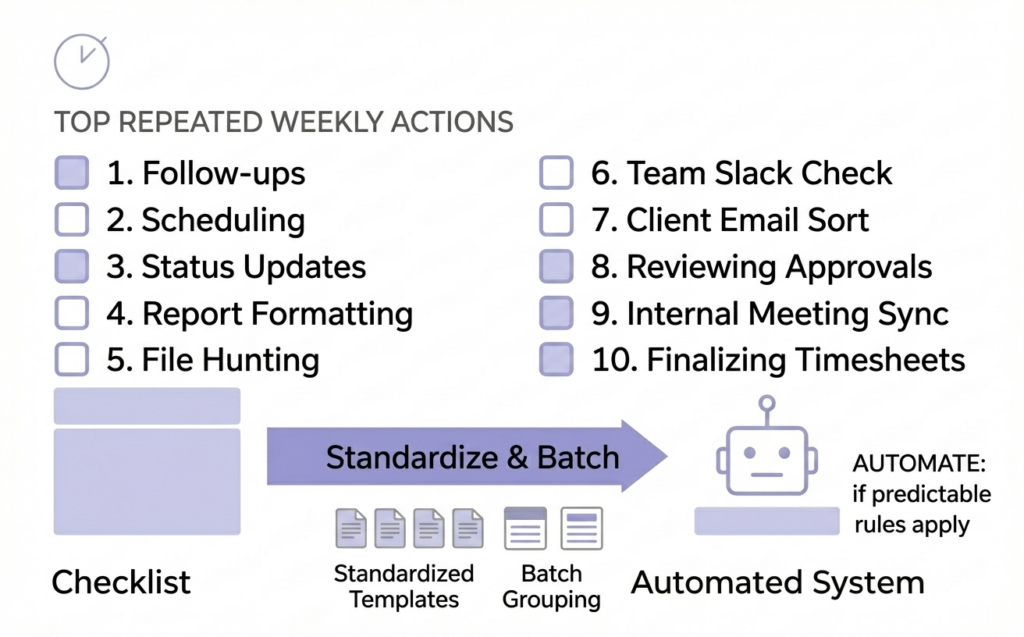
Many businesses drown in tiny actions: follow-ups, scheduling, status updates, report formatting, file hunting. These actions feel harmless. They create process bottlenecks because they consume attention and break focus.
You’ll hear:
- “It’ll only take five minutes.”
- “I’ll just do it manually this time.”
- “I’m slammed, but I didn’t ship anything important.”
Fix it:
- List the top 10 repeated weekly actions.
- Standardize and batch them.
- Automate the actions that follow predictable rules.
Even Stanford researchres agree: Heavy mutlitaskers aren’t “better operators”. (https://news.stanford.edu/stories/2009/08/multitask-research-study-082409)
6) Clients experience delays that nobody can explain
When a client asks, “Where is this at?” and your team guesses, your system lacks visibility. Low visibility feeds process bottlenecks because people spend time hunting answers instead of producing outputs.
Symptoms include:
- Status lives in Slack threads and inboxes.
- Teams use meetings to discover reality.
- You can’t predict delivery dates with confidence.
Fix it:
- Put every request into one tracking system.
- Track a single owner, a due date, and the next step.
- Send automated client updates at defined milestones.
See familiar problems?
Ask for a free audit.
7) You run constant firefighting instead of steady delivery
Firefighting feels productive because it creates urgency and motion. It also signals deep process bottlenecks because your system can’t absorb normal variance.
Look for:
- “Emergency” work interrupts planned work daily.
- People skip QA and create rework later.
- Leaders jump into execution to patch holes.
Fix it:
- Define SLAs and escalation rules.
- Add buffers at the riskiest steps.
- Remove the top 3 causes of rework before you “work harder.”
8) Rework loops drain your margins
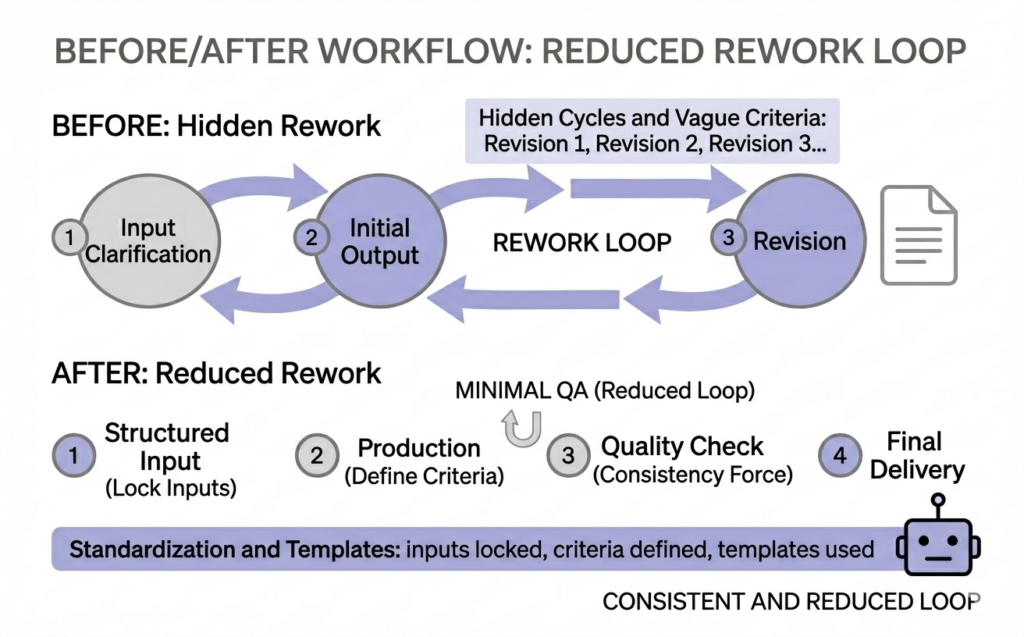
Rework hides as “client feedback” or “tightening the deliverable.” In reality, rework usually comes from unclear inputs, vague acceptance criteria, or inconsistent execution. Rework creates process bottlenecks because it adds invisible cycles.
Signals:
- You revise the same deliverable multiple times.
- You redo reporting because numbers don’t match.
- You fix invoices after clients complain.
Fix it:
- Lock inputs with structured forms and required fields.
- Define acceptance criteria before production starts.
- Use templates that force consistency.
9) Your tools don’t talk, so people act as the integration layer
If your team moves information between tools manually, you built a human API. Humans make great thinkers and terrible middleware. This pattern creates process bottlenecks because each handoff introduces delays, errors, and missing context.
You’ll see:
- People forward emails as “tasks.”
- People screenshot data because they can’t sync it.
- People chase files across Drive folders.
Fix it:
- Identify your core systems: CRM, project management, accounting, support, calendar.
- Define triggers that should create actions automatically.
- Build workflows that route work and update fields without manual steps.
10) You fail the “30% workload” test
Ask this, and don’t dodge it:
If workload increased by 30%, what would break first?
If you can answer immediately, you already know your weakest link. If you can’t answer, your business lacks operational clarity. Either way, you face process bottlenecks.
Use the follow-up questions:
- What exactly breaks first: speed, quality, cashflow, follow-up, delivery?
- Who becomes the choke point?
- What downstream fires appear after the break?
Fix it:
- Protect the step that breaks first.
- Reduce variance with better intake and clearer criteria.
- Automate the predictable work around that step.
A simple self-audit to confirm process bottlenecks
Score each statement from 0 (never) to 3 (constantly):
- Work piles up in one place.
- Approvals delay delivery.
- One person holds critical knowledge.
- We duplicate data across tools.
- We lose time to “quick tasks.”
- Clients ask for updates and we scramble.
- We redo work often.
- We rely on Slack and inboxes for workflow.
- We can’t predict timelines reliably.
- A 30% workload increase would cause chaos.
If you score 15+ total, you run clear process bottlenecks.
What to do after you spot process bottlenecks
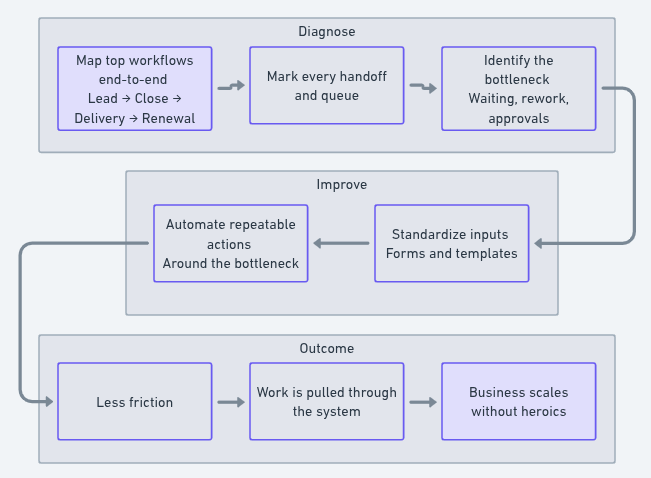
Don’t start by buying tools. Don’t start by hiring. Start by mapping flow.
- List your top workflows end-to-end (lead → close → delivery → renewal).
- Mark every handoff and every queue.
- Identify the step with the most waiting, rework, or approvals.
- Standardize inputs with forms and templates.
- Automate the repeatable actions around the bottleneck.
When you remove process bottlenecks, you stop pushing. Your business starts pulling work through a system that scales without heroics.
Torm Erik Raudvee
21.03.2026

Find your bottlenecks (for free)
Begin your journey with us now. Unlock the potential of your business with our innovative solutions designed to boost your success and propel you towards your goals.